
Government, law and civic participation
Tarea 1. Gobierno, legislación y participación ciudadana
The exam includes 10 of 25 questions from this block. Below are all the questions of the block from the official 2026 manual, each with an English translation, the correct answer and an explanation.
Practise this blockTap an option to see instantly if it's right. Your progress is saved.
- 1001
España es…
Spain is…
CorrectWrong
Correct answer: una monarquía parlamentaria.
Spain has a king, but he does not govern: the country is run by a government that relies on parliament. Hence the name, monarquía parlamentaria. Spain is not a federation; it is divided into autonomous communities.
- 1002
La ley fundamental de España se llama…
What is the fundamental law of Spain called?
CorrectWrong
Correct answer: Constitución.
The country's supreme law is the Constitución. The current one was adopted in 1978, and every other law must comply with it. The manual calls it the “ley de leyes”, the law of laws.
 constitution of SpainWikipedia Photo: Cortes Constituyentes · Public domain
 - 1003
Según la Constitución española, la soberanía nacional reside en…
According to the Spanish Constitution, national sovereignty belongs to…
CorrectWrong
Correct answer: el pueblo español.
Article 1 of the Constitution: sovereignty belongs to the Spanish people, from whom all the powers of the State emanate. The Government and the Congress get their powers from the people, not the other way round.
- 1004
El Instituto de las Mujeres es…
The Women's Institute (Instituto de las Mujeres) is…
CorrectWrong
Correct answer: un organismo español.
The Instituto de las Mujeres is a Spanish public body that belongs to the Ministry of Equality. It is neither an NGO nor a European institution.
- 1005
¿Cuándo puedo hacer los trámites en la sede electrónica?
When can I carry out procedures on the electronic office (sede electrónica)?
CorrectWrong
Correct answer: En cualquier horario.
The sede electrónica is open 24 hours a day, weekends included. That is its main advantage: you don't have to fit around office hours or queue.
- 1006
El castellano o español es lengua oficial…
Castilian or Spanish is an official language…
CorrectWrong
Correct answer: en toda España.
Castilian (also called Spanish) is official throughout Spain. Regions with their own language have two official languages, but Spanish is still official there. The whole Iberian Peninsula is wrong: it also includes Portugal and Andorra.
- 1007
¿Cuál de estas fuerzas de seguridad es de ámbito autonómico?
Which of these security forces operates at the level of an autonomous community?
CorrectWrong
Correct answer: Policía Foral de Navarra.
The Policía Foral de Navarra only works in Navarre, so it is a regional police force. The Policía local belongs to the town council, and the Guardia Civil is a nationwide force.
 Policía ForalWikipedia Photo: Zarateman · CC0
 - 1008
¿Qué fuerza de seguridad está en toda España?
Which security force operates throughout Spain?
CorrectWrong
Correct answer: El Cuerpo Nacional de Policía.
The Cuerpo Nacional de Policía works across the whole country. The Policía Foral only operates in Navarre and the Mossos d'Esquadra only in Catalonia.
 National Police Corps of SpainWikipedia Photo: Paul Townley · Public domain
 - 1009
En la Constitución se establece la separación de poderes: el poder ejecutivo, el legislativo y el…
The Constitution establishes the separation of powers: executive, legislative and…
CorrectWrong
Correct answer: judicial.
The classic separation of powers: the executive belongs to the Government, the legislative to the Cortes and the judicial to the judges. There is no “informative” or “political” branch.
- 1010
La bandera de España debe utilizarse…
The flag of Spain must be flown…
CorrectWrong
Correct answer: en todos los edificios públicos.
The Spanish flag is compulsory on all public buildings. Autonomous communities fly their own flag next to it, not instead of it.
- 1011
¿Quién es el jefe del Estado en España?
Who is the head of State in Spain?
CorrectWrong
Correct answer: El rey.
The head of State is the King, currently Felipe VI. The President of the Government leads the executive but is not the head of State. People often mix up these two roles in the exam.
 Felipe VI of SpainWikipedia Photo: Saeima · CC BY-SA 2.0
 - 1012
La gestión de la sanidad es competencia de…
The management of healthcare is the responsibility of…
CorrectWrong
Correct answer: las comunidades autónomas.
Healthcare and education were transferred to the autonomous communities. That is why your health card (tarjeta sanitaria) is issued by your regional service, for example SERMAS in Madrid or SAS in Andalusia.
- 1013
¿Quién fue el primer presidente del Gobierno de España en democracia?
Who was the first President of the Government of Spain in democracy?
CorrectWrong
Correct answer: Adolfo Suárez.
The first President of democratic Spain was Adolfo Suárez of the UCD party. Rajoy and Zapatero led the country in the 21st century.
- 1014
¿Cuál de estos organismos se encarga de interpretar la Constitución?
Which of these bodies is responsible for interpreting the Constitution?
CorrectWrong
Correct answer: El Tribunal Constitucional.
The Tribunal Constitucional interprets the Constitution and is independent of the other powers. The Consejo General del Poder Judicial governs the judiciary, and “Poder Constitucional” is a made-up option.
 Constitutional Court of SpainWikipedia Photo: K3T0 · CC BY 3.0
 - 1015
¿Quién modera el funcionamiento de las instituciones españolas?
Who moderates the functioning of the Spanish institutions?
CorrectWrong
Correct answer: El rey.
Under the Constitution the King acts as arbiter and makes sure the institutions work properly. He does not take political decisions.
Felipe VI of SpainWikipedia Photo: Saeima · CC BY-SA 2.0 - 1016
¿Cómo se llama la cámara de representación territorial en España?
What is the chamber of territorial representation in Spain called?
CorrectWrong
Correct answer: Senado.
The Senado is the chamber of territorial representation: some senators are appointed by the autonomous communities themselves. The Congreso represents the citizens as a whole.
 Palace of the SenateWikipedia Photo: Esetena · CC BY-SA 3.0
 - 1017
¿Qué se necesita para hacer trámites por internet con la Administración?
What do you need to carry out procedures with the Administration online?
CorrectWrong
Correct answer: Una firma electrónica.
Online procedures require an electronic signature: the electronic DNI, a digital certificate (certificado digital) or the Cl@ve system. Legally it is equivalent to a signature on paper.
- 1018
¿Cómo se aprobó la Constitución?
How was the Constitution approved?
CorrectWrong
Correct answer: Por referéndum.
The Constitution was approved by referendum on 6 December 1978. That is why 6 December is a public holiday in Spain, the Día de la Constitución.
- 1019
¿Cómo se llama la ley más importante de cada comunidad autónoma?
What is the most important law of each autonomous community called?
CorrectWrong
Correct answer: Estatuto de Autonomía.
Every autonomous community has an Estatuto de Autonomía. It sets out the region's name, borders, institutions and powers. It is the region's main law, but it is subordinate to the Constitution.
- 1020
Las instalaciones culturales y deportivas públicas son competencia del…
Public cultural and sports facilities are the responsibility of the…
CorrectWrong
Correct answer: Ayuntamiento.
Municipal swimming pools, sports centres and cultural centres belong to the ayuntamiento. No ministry runs these facilities.
- 1021
¿Quién dirige la administración militar de España?
Who directs Spain's military administration?
CorrectWrong
Correct answer: El Gobierno.
The Government directs domestic and foreign policy, the civil and military administration and defence. Supreme command formally belongs to the King, but the Government runs the armed forces through the Ministry of Defence.
- 1022
¿Qué hay en las Islas Baleares, en vez de diputaciones?
What do the Balearic Islands have instead of provincial councils (diputaciones)?
CorrectWrong
Correct answer: Consejos insulares.
The Balearic Islands have Consejos insulares, one per island, instead of provincial councils. Cabildos only exist in the Canary Islands.
- 1023
¿Qué ciudad tiene más habitantes?
Which city has the most inhabitants?
CorrectWrong
Correct answer: Barcelona.
Barcelona is the second most populous city after Madrid. Next come Valencia, Seville and Zaragoza.
 BarcelonaWikipedia Photo: dronepicr · CC BY 2.0
 - 1024
Las Cortes Generales representan…
The Cortes Generales represent…
CorrectWrong
Correct answer: al pueblo español.
The Cortes, that is, parliament, represent the Spanish people. Parties and ministers are wrong: ministers belong to the Government, not to parliament.
- 1025
El Congreso de los Diputados y el Senado constituyen el poder…
The Congress of Deputies and the Senate make up the … power.
CorrectWrong
Correct answer: legislativo.
Together the Congress and the Senate form the Cortes Generales, the legislative power. They pass laws and the budget and oversee the Government.
- 1026
¿Cómo pueden los ciudadanos proponer nuevas leyes al Congreso?
How can citizens propose new laws to Congress?
CorrectWrong
Correct answer: Reuniendo 500 000 firmas.
Citizens can put forward a bill themselves; this is called the iniciativa legislativa popular. It requires at least 500,000 signatures.
- 1027
¿Cuántas comunidades autónomas hay en España?
How many autonomous communities are there in Spain?
CorrectWrong
Correct answer: 17.
Spain has 17 autonomous communities plus 2 autonomous cities, Ceuta and Melilla. The question asks about communities, so the answer is 17.
 autonomous community of SpainWikipedia Photo: Rodriguillo, edited by User:majda la mas nuca la menos y menos masomenos · CC BY-SA 3.0
 - 1028
Los colores de la bandera española son…
The colours of the Spanish flag are…
CorrectWrong
Correct answer: rojo y amarillo.
The Spanish flag has three stripes: red, yellow (twice as wide) and red again. There is no white on it.
- 1029
¿Dónde está la sede del Gobierno de España?
Where is the seat of the Government of Spain?
CorrectWrong
Correct answer: En Madrid.
The Government sits in Madrid, the capital. Madrid became the capital in the mid-16th century; before that the role was played by Valladolid and Toledo.
- 1030
La bandera azul con 12 estrellas amarillas en círculo es la bandera de…
The blue flag with 12 yellow stars in a circle is the flag of…
CorrectWrong
Correct answer: la Unión Europea.
The blue flag with 12 yellow stars in a circle is the flag of the European Union. The European Parliament has no separate flag of its own; it uses the EU flag.
- 1031
En las elecciones municiales se vota a…
In municipal elections people vote for…
CorrectWrong
Correct answer: alcaldes y concejales
Municipal elections choose the concejales, the members of the town council, who then elect the alcalde. Deputies and senators are chosen in general elections, and ministers are not elected by anyone.
- 1032
¿Qué lengua es oficial en el País Vasco?
Which language is official in the Basque Country?
CorrectWrong
Correct answer: El euskera.
In the Basque Country, Spanish and Basque (euskera) are official. Bable is the Asturian dialect and aragonés is Aragonese; neither has official status.
- 1033
Todos los españoles tienen el deber de conocer la lengua…
All Spaniards have the duty to know the … language.
CorrectWrong
Correct answer: oficial del Estado.
Article 3 of the Constitution: every Spaniard has the duty to know Castilian, the official language of the State, and the right to use it. Regional languages are learned according to each community's rules.
- 1034
El aranés es una lengua cooficial que se habla en un pequeño territorio de…
Aranese is a co-official language spoken in a small area of…
CorrectWrong
Correct answer: Cataluña.
Aranese (aranés) is the Occitan dialect of the Val d'Aran in the Pyrenees. The valley belongs to Catalonia, so Catalonia has three official languages: Spanish, Catalan and Aranese.
 Val d'AranWikipedia Photo: Tschubby · CC BY-SA 3.0
 - 1035
Las instituciones de una comunidad autónoma son: el consejo de gobierno, el presidente y…
The institutions of an autonomous community are: the governing council, the president and…
CorrectWrong
Correct answer: la asamblea legislativa.
An autonomous community is organised like a small state: a parliament (asamblea legislativa), a government (consejo de gobierno) and a president.
- 1036
¿Cuál de estas opciones es una lengua cooficial en alguna comunidad autónoma?
Which of these is a co-official language in an autonomous community?
CorrectWrong
Correct answer: El gallego.
Galician (gallego) is official in Galicia alongside Spanish. Aragonese and Murcian have no official status.
 languages of SpainWikipedia Photo: FogueraC · Public domain
 - 1037
¿Qué institución tiene como fin la promoción de la enseñanza de la lengua española y la difusión de la cultura en español?
Which institution aims to promote the teaching of the Spanish language and spread culture in Spanish?
CorrectWrong
Correct answer: El Instituto Cervantes.
The Instituto Cervantes promotes the Spanish language and culture around the world. It also runs the DELE exams and the very CCSE you are preparing for.
- 1038
¿Cuál de los siguientes organismos trabaja para conseguir la normalización lingüística?
Which of the following bodies works to standardise the language?
CorrectWrong
Correct answer: La Real Academia Española.
Language norms are set by the Real Academia Española: it decides what is correct in writing and speech. The Instituto Cervantes and the Institut Ramon Llull promote languages; they do not set norms.
 Royal Spanish AcademyWikipedia Photo: Heralder · CC BY-SA 3.0
 - 1039
¿Dónde vive el presidente del Gobierno?
Where does the President of the Government live?
CorrectWrong
Correct answer: En el Palacio de la Moncloa.
The President of the Government lives in the Palacio de la Moncloa. The King lives in the Zarzuela, and the Palacio Real is used for official ceremonies.
- 1040
¿Cuál de los siguientes cuerpos forma parte de las Fuerzas Armadas de España?
Which of the following corps is part of Spain's Armed Forces?
CorrectWrong
Correct answer: El Ejército del Aire.
The Armed Forces are the Army, the Air Force (Ejército del Aire) and the Navy (Armada). The Guardia Civil and the Policía Foral are security forces, not the military.
 Spanish Air and Space ForceWikipedia Photo: This vector image includes elements that have been taken or adapted from this fi · CC BY-SA 3.0
 - 1041
¿Quiénes forman parte del Gobierno?
Who is part of the Government?
CorrectWrong
Correct answer: Los ministros.
The Government is made up of the President, the Vice-Presidents and the ministers. Mayors and councillors belong to the municipal level.
- 1042
España es un…
Spain is a…
CorrectWrong
Correct answer: estado social y democrático de Derecho.
Article 1 of the Constitution: Spain is a social and democratic State under the rule of law (estado social y democrático de Derecho). This formula is worth learning word for word.
- 1043
¿Cuál de las siguientes siglas corresponde a un partido político?
Which of these acronyms stands for a political party?
CorrectWrong
Correct answer: PP.
PP is the Partido Popular. PIB means gross domestic product (GDP), and UE is the European Union.
- 1044
¿Qué título tiene la futura reina, hija del rey?
What title does the future queen, the King's daughter, hold?
CorrectWrong
Correct answer: Princesa de Asturias.
The heir to the throne holds the title Príncipe or Princesa de Asturias. Today that is Leonor, the elder daughter of Felipe VI.
 Leonor, Princess of AsturiasWikipedia Photo: Pool Moncloa/Borja Puig de la Bellacasa · Attribution
 - 1045
¿Con qué rey se restaura la democracia en España después del régimen de Franco?
Under which king was democracy restored in Spain after Franco's regime?
CorrectWrong
Correct answer: Con Juan Carlos I.
Juan Carlos I became king in 1975, after Franco's death, and supported the transition to democracy. Alfonso XIII reigned until 1931 and Charles III in the 18th century.
 Juan Carlos I of SpainWikipedia Photo: Irekia · CC BY 2.0
 - 1046
¿En qué año se aprobó la Constitución española?
In what year was the Spanish Constitution approved?
CorrectWrong
Correct answer: En 1978.
The Constitution of 1978, approved by referendum on 6 December. Remember this date: other questions test it too.
constitution of SpainWikipedia Photo: Cortes Constituyentes · Public domain - 1047
¿Cuántas comunidades autónomas tienen su propia bandera?
How many autonomous communities have their own flag?
CorrectWrong
Correct answer: Todas.
Every community has its own flag, and it is flown on official buildings together with the Spanish one. Having its own language has nothing to do with it.
- 1048
¿Qué organismo oficial atiende las quejas de los ciudadanos por el mal funcionamiento de las administraciones?
Which official body handles citizens' complaints about the poor functioning of public administrations?
CorrectWrong
Correct answer: El Defensor del Pueblo.
Complaints about the administration go to the Defensor del Pueblo, the ombudsman. It is free, and anyone can file a complaint.
 Spanish OmbudsmanWikipedia Photo: Prensa Defensor del Pueblo · CC BY-SA 4.0
 - 1049
¿Cuántas firmas, como mínimo, deben recoger los ciudadanos para poder presentar una proposición de ley?
What is the minimum number of signatures citizens must collect to submit a bill?
CorrectWrong
Correct answer: 500 000.
A popular legislative initiative needs at least 500,000 signatures. The same number appears in question 1026.
- 1050
¿A cuál de las siguientes organizaciones internacionales pertenece España?
Which of the following international organisations does Spain belong to?
CorrectWrong
Correct answer: Fondo Monetario Internacional (FMI).
Spain is a member of the IMF (FMI), as well as the UN, NATO, the Council of Europe and the World Bank. The CIS and the Eurasian Economic Union group post-Soviet countries.
- 1051
En la organización de la Administración se distinguen tres niveles: central, autonómica y…
The Administration is organised on three levels: central, regional and…
CorrectWrong
Correct answer: local.
The levels of administration are central (the State), regional (the communities) and local. The local level includes provinces and municipalities.
- 1052
El poder legislativo corresponde...
Legislative power belongs to…
CorrectWrong
Correct answer: a los diputados y senadores.
Legislative power belongs to the Cortes, that is, the deputies of the Congress and the senators. The President and the ministers are the executive; judges are the judiciary.
- 1053
¿Dónde vive el rey?
Where does the King live?
CorrectWrong
Correct answer: En el Palacio de la Zarzuela.
The King lives in the Palacio de la Zarzuela near Madrid. The Palacio de la Moneda is in Chile, the Chilean president's seat, and the Moncloa is the home of the President of the Government.
 Palace of ZarzuelaWikipedia Photo: Juan Gómez de Mora · Public domain
 - 1054
El nombre oficial del parlamento español es…
The official name of the Spanish parliament is…
CorrectWrong
Correct answer: Cortes Generales.
The official name of parliament is Cortes Generales. The Congress and the Senate are its chambers; neither of them alone is the whole parliament.
- 1055
El Instituto de Comercio Exterior de España, el Instituto de las Mujeres y la Dirección General de Tráfico…
The Spanish Institute for Foreign Trade, the Women's Institute and the Directorate-General for Traffic…
CorrectWrong
Correct answer: dependen de ministerios.
The DGT, ICEX and the Instituto de las Mujeres report to ministries. For example, the DGT belongs to the Ministry of the Interior.
- 1056
¿Quién puede reinar en España?
Who can reign in Spain?
CorrectWrong
Correct answer: Tanto los hombres como las mujeres.
Both men and women can inherit the Spanish throne. The future queen, Princess Leonor, is a clear example.
- 1057
El Tribunal de Cuentas depende de…
The Court of Auditors (Tribunal de Cuentas) depends on…
CorrectWrong
Correct answer: las Cortes Generales.
The Tribunal de Cuentas checks how the State spends money and reports to the Cortes. If it depended on the Government or the Ministry of Finance, the Government would be auditing itself.
- 1058
¿Quién es la tercera autoridad del Estado, después del rey y el presidente del Gobierno?
Who is the third authority of the State, after the King and the President of the Government?
CorrectWrong
Correct answer: El presidente del Congreso de los Diputados.
The order is: the King, the President of the Government, the President of the Congress of Deputies. The President of the Senate comes lower on the list.
- 1059
¿Qué lengua cooficial se habla en las Islas Baleares?
Which co-official language is spoken in the Balearic Islands?
CorrectWrong
Correct answer: Catalán.
In the Balearic Islands, Spanish and Catalan are official. The local varieties are called mallorquín or menorquín, but the correct exam answer is catalán.
 Balearic IslandsWikipedia Photo: TUBS · CC BY-SA 3.0
 - 1060
La Constitución defiende valores tales como la libertad, la igualdad, el pluralismo político y…
The Constitution upholds values such as freedom, equality, political pluralism and…
CorrectWrong
Correct answer: la justicia.
The higher values in Article 1 of the Constitution are freedom, justice, equality and political pluralism. Solidarity and fraternity are not on that list, so don't mix them up.
- 1061
Cuando una ley ya está aprobada, ¿qué necesita para poder aplicarse?
Once a law has been passed, what does it need before it can be applied?
CorrectWrong
Correct answer: Normas que la desarrollen.
A new law often can't work on its own: the Government or a ministry issues regulations (reglamentos) and ministerial orders (órdenes ministeriales) that fill in the details.
- 1062
¿Cuántos habitantes hay en España?
How many people live in Spain?
CorrectWrong
Correct answer: 49 millones.
In 2025 Spain had just over 49 million inhabitants. That makes it the fourth most populous EU country, after Germany, France and Italy.
- 1063
¿Cuál de estos es un órgano consultivo del Gobierno de España?
Which of these is an advisory body of the Spanish Government?
CorrectWrong
Correct answer: El Consejo de Estado.
The Consejo de Estado is the Government's advisory body. The other one is the Consejo Económico y Social. The Tribunal Constitucional does not advise the Government; it interprets the Constitution.
- 1064
¿Quién dirige la política interior y exterior de España?
Who directs Spain's domestic and foreign policy?
CorrectWrong
Correct answer: El Gobierno.
Domestic and foreign policy is directed by the Government. The King has a representative role, and the Congress passes laws and oversees the Government.
- 1065
El Defensor del Pueblo depende de…
The Ombudsman (Defensor del Pueblo) depends on…
CorrectWrong
Correct answer: las Cortes Generales.
The Defensor del Pueblo is elected by the Congress and the Senate and reports to the Cortes. The term lasts five years, and the Ombudsman takes orders from no one.
- 1066
El Instituto Etxepare tiene como misión la difusión del…
The mission of the Etxepare Institute is to promote…
CorrectWrong
Correct answer: euskera y la cultura vasca.
The Instituto Etxepare promotes the Basque language and culture abroad. The name is a clue: Bernat Etxepare wrote the first book in Basque.
- 1067
¿Cuál de estas ciudades se encuentra entre las 10 más pobladas de España?
Which of these cities is among the 10 most populous in Spain?
CorrectWrong
Correct answer: Málaga.
Málaga is sixth by population, after Madrid, Barcelona, Valencia, Seville and Zaragoza. Cádiz and Albacete are not in the top ten.
- 1068
¿Quién puede realizar trámites en línea ante la Administración Pública?
Who can carry out online procedures with the Public Administration?
CorrectWrong
Correct answer: Cualquier ciudadano.
Online procedures are open to any citizen with an electronic signature. You don't need to be a lawyer or a civil servant.
- 1069
¿Cómo se llama el rey de España?
What is the name of the King of Spain?
CorrectWrong
Correct answer: Felipe VI.
The current King is Felipe VI. Juan Carlos I is his father and Alfonso XIII his great-grandfather.
Felipe VI of SpainWikipedia Photo: Saeima · CC BY-SA 2.0 - 1070
¿Cómo se llama el órgano de gobierno de los jueces y magistrados?
What is the governing body of judges and magistrates called?
CorrectWrong
Correct answer: Consejo General del Poder Judicial.
The judiciary is governed by the Consejo General del Poder Judicial (CGPJ), which guarantees judges' independence. The Tribunal Supremo is the highest court, but it is not a governing body.
- 1071
¿Quién aprueba los presupuestos generales del Estado?
Who approves the State's general budget?
CorrectWrong
Correct answer: Las Cortes Generales.
The State budget (Presupuestos Generales del Estado) is drafted by the Government and approved by the Cortes. In the exam, the right answer is whoever approves it.
- 1072
La Constitución española es…
The Spanish Constitution is…
CorrectWrong
Correct answer: la ley fundamental.
The Constitution is the fundamental law (ley fundamental); nothing in Spanish law ranks above it. It cannot be a secondary law or part of another law.
- 1073
Las Cortes Generales están compuestas por el Senado y…
The Cortes Generales are made up of the Senate and…
CorrectWrong
Correct answer: el Congreso de los Diputados.
The Cortes have two chambers: the Congreso de los Diputados and the Senado. The Supreme Court and the Council of State are not part of parliament.
 Palacio de las CortesWikipedia Photo: Luis García (Zaqarbal) · CC BY-SA 4.0
 - 1074
¿Quién elabora las leyes?
Who makes the laws?
CorrectWrong
Correct answer: El poder legislativo.
Laws are drafted and passed by the legislative power, that is, the Cortes. The Government can propose a bill, but parliament decides.
- 1075
La defensa de la integridad territorial de España corresponde a…
Defending Spain's territorial integrity is the job of…
CorrectWrong
Correct answer: las Fuerzas Armadas.
Defending Spain's territorial integrity is the army's job. The police and the Guardia Civil are responsible for people's safety inside the country.
- 1076
El Ejército español participa desde 1989 en misiones de paz de la…
Since 1989 the Spanish army has taken part in peacekeeping missions of the…
CorrectWrong
Correct answer: Organización de las Naciones Unidas (ONU).
Since 1989 Spanish troops have served in UN peacekeeping missions. A memory aid: that same year Spain held the presidency of the Council of the EU for the first time.
- 1077
¿Quién vigila puertos y aeropuertos, fronteras y costas?
Who guards ports and airports, borders and coasts?
CorrectWrong
Correct answer: La Guardia Civil.
Ports, airports, borders and coasts are guarded by the Guardia Civil. An easy way to remember: the Guardia Civil covers every “perimeter”, including the roads between towns.
 Civil GuardWikipedia Photo: Dickelbers · CC BY-SA 3.0
 - 1078
¿Quién hace el control de pasaportes en las fronteras de España?
Who carries out passport control at Spain's borders?
CorrectWrong
Correct answer: La Policía Nacional.
Passports at the border are checked by the Policía Nacional, which also issues DNIs and passports and handles foreigners' affairs. The Guardia Civil guards the border itself, but documents are checked by the police.
National Police Corps of SpainWikipedia Photo: Paul Townley · Public domain - 1079
¿Cuál de los siguientes políticos ha sido presidente del Gobierno en España?
Which of these politicians has been President of the Government of Spain?
CorrectWrong
Correct answer: José María Aznar.
José María Aznar (PP) was President of the Government from 1996 to 2004. Manuel Fraga founded the party that became the PP, but never led the Government. Yolanda Díaz has been a Vice-President.
 José María AznarWikipedia Photo: Xavier Lejeune · CC BY 4.0
 - 1080
¿Cómo se llama la policía autonómica de Cataluña?
What is the regional police of Catalonia called?
CorrectWrong
Correct answer: Mossos d'Esquadra.
Catalonia's regional police is the Mossos d'Esquadra. The Ertzaintza is the police of the Basque Country.
 Mossos d'EsquadraWikipedia Photo: Jordi Roca · CC BY-SA 2.0
 - 1081
¿Cómo se llama la policía autonómica del País Vasco?
What is the regional police of the Basque Country called?
CorrectWrong
Correct answer: Ertzaintza.
The Ertzaintza is the Basque Country's police; the name is Basque. The Mossos d'Esquadra work in Catalonia.
 ErtzaintzaWikipedia Photo: Kevin.B · CC BY-SA 4.0
 - 1082
¿Desde qué año es rey Felipe VI?
Since what year has Felipe VI been King?
CorrectWrong
Correct answer: Desde 2014.
Felipe VI became King in June 2014, when his father Juan Carlos I abdicated. It was Juan Carlos who took the throne in 1975.
Felipe VI of SpainWikipedia Photo: Saeima · CC BY-SA 2.0 - 1083
¿Quién regula el tráfico en los pueblos y ciudades?
Who directs traffic in towns and cities?
CorrectWrong
Correct answer: La Policía Local.
Traffic in towns and cities is handled by the Policía Local. The Guardia Civil looks after the roads between towns.
 Municipal policeWikipedia Photo: Jotamad · CC BY-SA 4.0
 - 1084
¿Quién puede presentar una queja al Defensor del Pueblo?
Who can file a complaint with the Ombudsman (Defensor del Pueblo)?
CorrectWrong
Correct answer: Todos los ciudadanos, españoles o extranjeros.
Anyone can complain to the Defensor del Pueblo: Spanish or foreign, with or without papers, adult or minor. It is free.
- 1085
En España el voto en las elecciones es…
In Spain, voting in elections is…
CorrectWrong
Correct answer: un derecho.
Voting in Spain is a right. There is no fine for not voting.
- 1086
¿Quién vigila el tráfico en las carreteras?
Who monitors traffic on the roads?
CorrectWrong
Correct answer: La Guardia Civil.
Traffic on intercity roads is policed by the Guardia Civil (its Agrupación de Tráfico). The Policía Nacional does not deal with traffic.
 Agrupación de Tráfico de la Guardia CivilWikipedia Photo: Pilar Ponte · CC BY-SA 2.0
 - 1087
¿Qué organismo se encarga de recaudar los impuestos?
Which body collects taxes?
CorrectWrong
Correct answer: La Agencia Tributaria.
Taxes are collected by the Agencia Tributaria (AEAT), which reports to the Ministry of Finance. The Tribunal de Cuentas only audits spending, and the Consejo Económico y Social advises the Government.
- 1088
¿Dónde se publican las leyes nacionales?
Where are national laws published?
CorrectWrong
Correct answer: En el Boletín Oficial del Estado (BOE).
Laws are published in the Boletín Oficial del Estado (BOE). After publication a law comes into force, usually 20 days later unless it says otherwise.
 Boletín Oficial del EstadoWikipedia Photo: Agencia Estatal del Boletín Oficial del Estado · Public domain
 - 1089
¿Cómo se llaman los órganos de gobierno que solo existen en Canarias?
What are the governing bodies that exist only in the Canary Islands called?
CorrectWrong
Correct answer: Cabildos.
Cabildos govern the individual islands and exist only in the Canary Islands. In the Balearics, the Consejos insulares play a similar role.
- 1090
¿Cuál de estos trámites administrativos puede realizarse en la sede electrónica?
Which of these procedures can be done on the electronic office (sede electrónica)?
CorrectWrong
Correct answer: Pagar los impuestos.
Taxes can be paid online through the sede electrónica. The DNI and the passport are only issued in person at the police, where they take your fingerprints and photo.
- 1091
¿Cuál es el número de teléfono de información de la Administración General del Estado?
What is the information phone number of the General State Administration?
CorrectWrong
Correct answer: 060.
060 is the central administration's information line. 010 is the information line of many town councils, and 091 is the Policía Nacional. They are easy to mix up, which is why this is often tested.
- 1092
España está organizada en…
Spain is organised into…
CorrectWrong
Correct answer: comunidades autónomas.
Spain is divided into autonomous communities. Cantons exist in Switzerland, and states in the USA or Germany.
- 1093
¿Cuántos partidos políticos hay en España?
How many political parties are there in Spain?
CorrectWrong
Correct answer: Muchos.
Spain has a multi-party system (pluripartidismo): at every level of election, voters choose among many parties.
- 1094
¿Dónde tiene lugar la investidura del presidente del Gobierno?
Where is the investiture of the President of the Government held?
CorrectWrong
Correct answer: En el Congreso de los Diputados.
The investiture takes place in the Congress of Deputies: the King proposes a candidate and the deputies hold a vote of confidence. The Senate plays no part in it.
Palacio de las CortesWikipedia Photo: Luis García (Zaqarbal) · CC BY-SA 4.0 - 1095
¿Quién tiene el mando supremo de las Fuerzas Armadas?
Who holds supreme command of the Armed Forces?
CorrectWrong
Correct answer: El rey.
Supreme command of the Armed Forces formally belongs to the King. In practice the Government runs the army through the Minister of Defence, but the exam answer is el rey.
- 1096
¿Quién es el representante del Estado en una comunidad autónoma?
Who represents the State in an autonomous community?
CorrectWrong
Correct answer: El delegado del Gobierno.
The State is represented in each community by the delegado del Gobierno. The community's president represents the region itself, not the central government.
- 1097
¿Cuántas provincias hay en España?
How many provinces are there in Spain?
CorrectWrong
Correct answer: 50.
Spain has 50 provinces. Ceuta and Melilla are not included: they are autonomous cities.
 province of SpainWikipedia Photo: Jotamar · CC BY-SA 3.0
 - 1098
La enseñanza de las lenguas cooficiales es competencia…
Teaching the co-official languages is the responsibility of…
CorrectWrong
Correct answer: de la comunidad autónoma.
Teaching regional languages in schools is regulated by the autonomous community. Education in general has been handed over to the regions.
- 1099
El poder ejecutivo corresponde…
Executive power belongs to…
CorrectWrong
Correct answer: al Gobierno del Estado.
Executive power belongs to the Government. The Cortes are the legislative power and the judges the judicial power.
- 1100
¿Cuántas cámaras hay en el Parlamento español?
How many chambers does the Spanish Parliament have?
CorrectWrong
Correct answer: Dos.
Parliament has two chambers: the Congress of Deputies and the Senate. This is called a bicameral system (bicameral).
- 1101
El suministro de agua y el alumbrado de las ciudades es competencia de…
Water supply and street lighting in towns are the responsibility of…
CorrectWrong
Correct answer: el ayuntamiento.
Water supply and street lighting are handled by the ayuntamiento, along with rubbish collection, public spaces and the local police.
- 1102
En materias como nacionalidad, inmigración, emigración o extranjería solo tiene competencia…
In matters such as nationality, immigration, emigration and foreigners' affairs, only … has powers.
CorrectWrong
Correct answer: el Estado.
Nationality, immigration, emigration and foreigners' affairs are exclusive powers of the State. That is why citizenship is granted by the Ministry of Justice, not by the region.
- 1103
¿Cuántas mujeres han sido presidentas de Gobierno en España?
How many women have been President of the Government in Spain?
CorrectWrong
Correct answer: Ninguna.
No woman has yet been President of the Government of Spain. There have been women Vice-Presidents, but that is a different post.
- 1104
Las relaciones internacionales son competencia de…
International relations are the responsibility of…
CorrectWrong
Correct answer: el Estado.
International relations belong only to the State. Some regions have offices abroad, but foreign policy stays with the central government.
- 1105
El Ayuntamiento está formado por el alcalde y…
The town council is made up of the mayor and…
CorrectWrong
Correct answer: los concejales.
The ayuntamiento is the alcalde (mayor) plus the councillors (concejales). Deputies and senators work in the Cortes.
- 1106
¿Quiénes forman el gobierno de las comunidades autónomas?
Who makes up the government of an autonomous community?
CorrectWrong
Correct answer: El presidente y los consejeros.
A regional government is the president plus the consejeros. Only members of the central Government are called ministers.
- 1107
¿Cuál es el órgano de gobierno en los municipios?
What is the governing body of a municipality?
CorrectWrong
Correct answer: El ayuntamiento.
A municipality is governed by the ayuntamiento. The diputación governs a province, and the cabildo an island in the Canaries.
- 1108
¿Cómo se llaman los órganos de gobierno de las provincias españolas?
What are the governing bodies of the Spanish provinces called?
CorrectWrong
Correct answer: Diputaciones.
A province is governed by the Diputación provincial. The exceptions are the islands (Cabildos in the Canaries, Consejos insulares in the Balearics) and single-province communities, which have no diputación.
- 1109
¿Cuál es el órgano superior del poder ejecutivo?
What is the highest body of executive power?
CorrectWrong
Correct answer: El Gobierno.
The highest executive body is the Government (Gobierno). The Cortes are the legislative power, and the army reports to the Government.
- 1110
El idioma español también se llama…
The Spanish language is also called…
CorrectWrong
Correct answer: castellano.
Spanish is also called castellano, after Castile, where it was born. Aragonese and Leonese are separate Romance dialects.
- 1111
¿A quiénes se elige en las elecciones al Parlamento Europeo?
Who is elected in the European Parliament elections?
CorrectWrong
Correct answer: A los eurodiputados.
European Parliament elections choose the MEPs (eurodiputados). They are held every five years, at the same time across the EU.
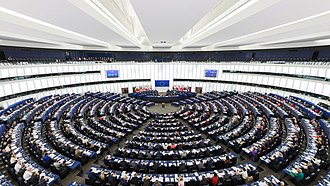 European ParliamentWikipedia Photo: Diliff · CC BY-SA 3.0
 - 1112
Los españoles pueden votar a partir de los…
Spaniards can vote from the age of…
CorrectWrong
Correct answer: 18 años.
You can vote from 18, and from the same age you can also stand for election.
- 1113
Algunos ciudadanos extranjeros pueden votar en las elecciones…
Some foreign citizens can vote in … elections.
CorrectWrong
Correct answer: municipales.
EU citizens living in Spain, and citizens of some countries that have an agreement with Spain, can vote in municipal elections. Only Spanish citizens vote in regional and general elections.
- 1114
¿Quién controla la gestión financiera del Estado?
Who oversees the financial management of the State?
CorrectWrong
Correct answer: El Tribunal de Cuentas.
The finances of the State and the parties are audited by the Tribunal de Cuentas, which reports to the Cortes. The Banco de España supervises banks, and the Agencia Tributaria collects taxes.
- 1115
¿A quiénes se elige en las elecciones generales?
Who is elected in general elections?
CorrectWrong
Correct answer: A los senadores y diputados.
General elections (elecciones generales) choose the deputies of the Congress and the senators. Councillors are elected in municipal elections and MEPs in European ones.
- 1116
¿Cuántos miembros tiene el Congreso de los Diputados?
How many members does the Congress of Deputies have?
CorrectWrong
Correct answer: 350.
The Congress of Deputies has 350 seats, elected by province. The Senate currently has 265 senators, but this question is about the Congress.
 Congress of DeputiesWikipedia Photo: Pool Moncloa/Fernando Calvo · Attribution
 - 1117
Los municipios y provincias forman parte de la Administración…
Municipalities and provinces are part of the … administration.
CorrectWrong
Correct answer: local.
Municipalities and provinces belong to the local administration (administración local).
- 1118
La comunidad autónoma más poblada de España es…
The most populous autonomous community in Spain is…
CorrectWrong
Correct answer: Andalucía.
The most populous community is Andalusia, with about 8.6 million people. Catalonia comes second.
- 1119
¿Cómo se llama la organización que defiende los intereses de los trabajadores?
What is the organisation that defends workers' interests called?
CorrectWrong
Correct answer: Sindicato.
Workers' interests are defended by a trade union (sindicato). The biggest unions, CCOO and UGT, negotiate with employers and the Government.
- 1120
¿Quién elige al presidente del Gobierno?
Who elects the President of the Government?
CorrectWrong
Correct answer: El Congreso de los Diputados.
The President of the Government is elected by the Congress of Deputies. The King only proposes a candidate after consulting the parties.


.jpg)

-2.jpg)
.jpg)


.jpg)


.svg)


.jpg)


.jpg)
.svg)

_17.jpg)


.jpg)

_-_1.jpg)


.jpg)


Questions and answers from the official Instituto Cervantes “Manual de preparación de la prueba CCSE 2026”.Manual on the Cervantes websiteIllustrations: Wikimedia Commons, free licences (CC BY-SA and others); the author is shown when you enlarge a photo.